Vibe coding breaks. Not immediately - the prototype looks great. But a month later: a monolith, 0.5% test coverage, process debt. Sound familiar?
The METR study (July 2025) showed that developers using AI were 19% slower on real-world tasks. The reason - debugging loops from unstructured prompts. Bad task definition leads to bad code.
What I did
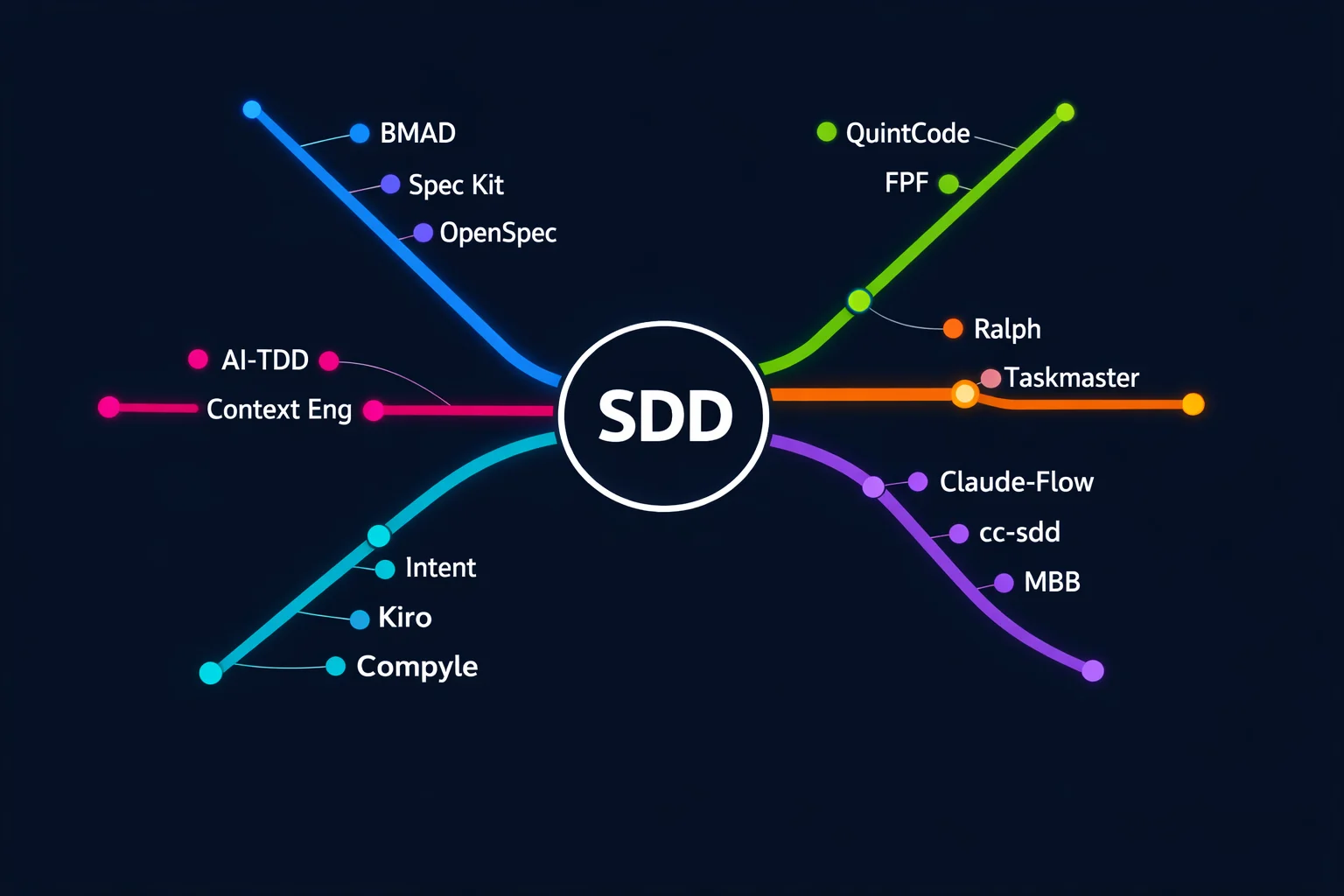
I spent two weeks gathering everything on Spec-Driven Development. YouTube streams, Telegram channel posts, Medium, Augment Code, Thoughtworks Radar, GitHub repos. The result - a catalog of 20+ frameworks in 6 categories.
Three frameworks that stood out
BMAD-METHOD (~41k stars) - simulates an entire agile team from AI roles. Analyst, PM, Architect, Scrum Master. High barrier to entry - overkill for a solo developer. But the output is a full PRD with architecture and dev stories. Perfect for a team of 3-5 people.
QuintCode + FPF - my favorite conceptually. ADI Cycle in 5 phases: hypothesize, verify logic, test, audit, decide. Solves the problem of “why did we choose this approach?” - three months later you won’t remember the reasoning.
FPF + ChatGPT Pro produced a 52-page spec + 280 feature files in 2 evenings. QuintCode chose Docker Swarm over the intuitive Kubernetes through the ADI cycle - cheaper and more stable.
cc-sdd (~2,880 stars) - Kiro-style SDD commands for 8 tools. Enforced workflow: Requirements - Design - Tasks. Won’t let you skip planning. Works in Claude Code, Cursor, Gemini CLI, Codex CLI and 4 more tools.
Maturity model
I found a useful SDD maturity model with three levels:
- Spec-First - spec per task, discarded after implementation
- Spec-Anchored - spec as a living document, changes start from it
- Spec-as-Source - spec is the only artifact, code is compiled output
Tessl ($125M raised) is building a platform on the third level. Essentially - code becomes a byproduct of specification. Sounds crazy, but $125M speaks for itself.
What I learned
SDD is not a fad and not waterfall in markdown (though critics say exactly that). AI agents generate good code when the task is well-defined. Without a spec - you’re rolling the dice.
“Hallucinations are not a bug but an architectural feature: the model fills in the gaps when you don’t set boundaries” - Denis Kiselyov. I’m still not sure which framework will become the standard. Maybe none - BMAD is great for teams, cc-sdd for solo, QuintCode for those who need a reasoning trail. But spec before code is already a necessity.
Full catalog with descriptions, comparison table and expert quotes: https://www.prodfeat.ai/en/sdd-guide