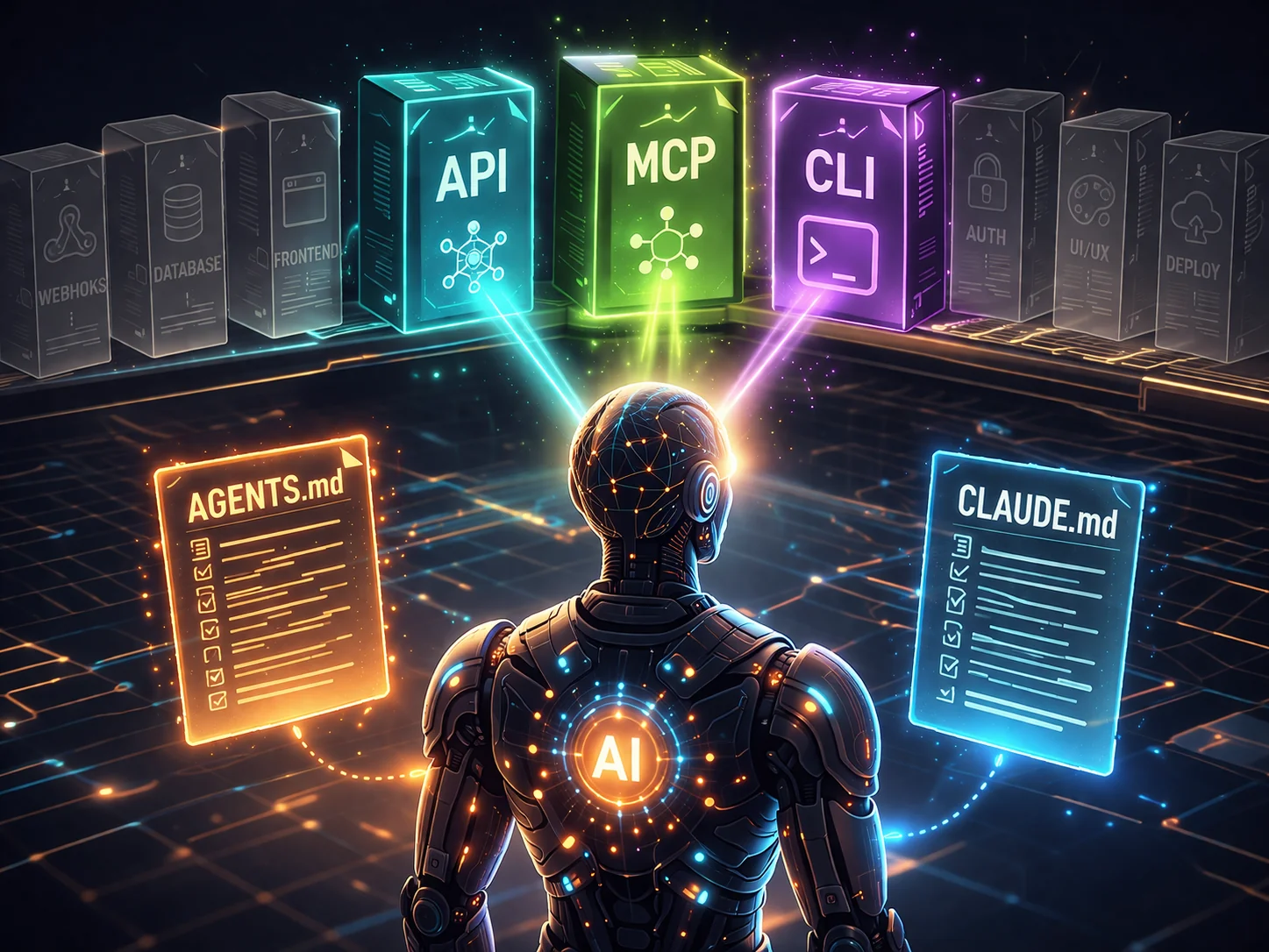
In the first part, I wrote about three layers of the agentic internet: interface, payments, identity. That was the macro picture. Now let’s talk practice: what exactly to do so your product is visible to AI agents.
Because a product without an agent-accessible interface is like a website without a mobile version in 2015. It works, but it’s already losing traffic.
Stripe Wins Not by Marketing
Amplifying research: 2,500 requests in Claude Code. “Add payments” - without specifying a tool. Stripe - 91% of recommendations. Vercel - 100% of deployments. Shadcn/ui - 90% of UI components.
Redux - zero. Zustand took everything.
A user says “add payments” - the agent has already decided it’s Stripe. Not because Stripe is the best. But because Stripe is visible to the agent. In 12 out of 20 categories, the agent built from scratch instead of recommending an existing tool.
The moment of conscious choice fades. The agent’s recommendation is the distribution.
The Fifth Channel
Aakash Gupta from Product Growth identifies five generations of distribution channels. Boxed software in stores (80s-90s). SEO and landing pages (2000s). App Store and mobile (2010s). AI Discovery - LLMs instead of links (2020s). And now the fifth: Agent Distribution.
The fifth channel differs from the fourth. AI Discovery is when a user asks ChatGPT “what’s the best email marketing service?” Agent Distribution is when a coding agent picks, installs, and integrates Resend on its own. No questions asked.
Insight Partners call this Agent-Led Growth. They have numbers: Supabase grew from 1 to 4.5 million developers in 12 months - the CEO directly attributes this to Bolt and Cursor. Resend gets 63% of agent selections for the task “add email.” 77% of buyers take the product their AI recommended.
The funnel doesn’t disappear - it accelerates. From problem awareness to production integration in minutes.
The Mobile Analogy
Remember 2015? A product without a mobile version still worked, but was already losing traffic. Everyone knew they needed to adapt. Some did it right away. Others waited two years and lost 40% of their audience.
Same story now. Only the question sounds different: “Is your product visible to an AI agent?”
Mind the Product writes: PMs should start with “how will the agent use this?” before “how will a human see this?” The Atlantic introduces the term AX - Agent Experience - as a new discipline alongside UX.
Five Levels of Visibility
What exactly makes a product visible to agents?
1. API with Machine-Readable Description
If a product has no API, the agent has nothing to work with. But an API alone isn’t enough. You need an OpenAPI spec - a description of every endpoint in a format the agent can read automatically.
Tools already exist that turn such a spec into a ready-made MCP server in minutes. Azure, SAP, dozens of open-source projects. The barrier to entry: “give us the spec - the rest generates itself.”
Peter Yang articulated the principle: every product feature should have a corresponding API. Not “API for developers,” but API as the primary product interface.
2. MCP Server
Model Context Protocol - the standard for connecting to AI agents. Growth from 2 million downloads in November 2024 to 97 million in March 2026 - 4,750% in 16 months. React reached comparable scale in three years.
Stripe, Vercel, Cloudflare, GitHub, Figma, Linear - all built their servers. Block (Square) eliminated 340 custom connectors with a single MCP implementation. Integration costs dropped 60-70%.
Stripe says directly: “MCP could become the default way services are accessed.” It’s like the App Store for agents. No MCP server - no distribution.
3. Agent-Friendly Documentation
API and MCP give the agent access to a product. Documentation determines how quickly it figures out what to do with it.
The agent picks Stripe not just because there’s an MCP server. But because behind that MCP server stands a 5-minute quickstart, an SDK with autocomplete, and code examples for every scenario. The agent literally copies a snippet from the docs and adapts it to the user’s task. A competitor’s API might be just as good - but if the docs are worse, the agent goes where it’s easier.
This works like developer experience, except the client is now an agent, not a human. The fewer steps from “I want to connect” to “it works in prod,” the higher the chance of recommendation.
4. Web Annotations
WebMCP - HTML attributes that mark interface elements for AI agents. Instead of scraping the DOM and guessing at buttons, the agent reads the element description directly.
Chrome 146, feature flag, early preview. Google included WebMCP in its list of key agentic web protocols. 59% of traffic on travel sites was bots even before LLMs. The web has long been not just for humans.
5. CLI
AI agents prefer the command line. Codex CLI deliberately avoids UI - when asked to paint a landscape, it writes a Python script. Computer Use is a fallback, not the primary tool.
The hierarchy: API > CLI > shortcuts > UI clicks.
Peter Steinberger from OpenClaw built 40 separate CLI tools that seemed like “failed projects” - together they became a successful agent-first product with 346,000+ GitHub stars.
What PMs Should Do
Distribution is changing. SEO, content marketing, PLG - they stay. But a new channel is being added. Stripe gets 91% not because of advertising. Because of its MCP server and documentation.
Agent-accessibility is the new responsive. Just as adaptive design became mandatory after the mobile revolution, agent-accessible interfaces will become mandatory within the next two years.
A product without an agent interface loses market share quietly. Not with a bang. The agent recommends a competitor. The user doesn’t even know an alternative existed.
Gartner forecasts: 40% of enterprise applications will include task-specific AI agents by the end of 2026. The AI agent market is valued at $7.8-10.9 billion in 2026, projected to reach $52 billion by 2030.
Checklist
- Does your product have an API with an OpenAPI spec?
- Does it have an MCP server?
- Does it have context files for agents (modular, not monolithic)?
- Are web forms annotated for agent interaction?
- Does the product work from the command line?
Every “no” is a point where the agent will choose a competitor.
Sources
- Amplifying - Claude Code Tool Recommendations
- Aakash Gupta - The PM’s Playbook for AI Agent Distribution
- Insight Partners - Agent-Led Growth: The New B2B Frontier
- Mind the Product - Agentic AI Forces a Reverse-Waterfall in PM
- From UX to AX - A PM Playbook for Agents
- Peter Yang - Build Your Product for AI Agents First
- MCP Ecosystem in 2026 - Universal Standard
- MCP Hits 97 Million Installs
- Google - Developer’s Guide to AI Agent Protocols
- Evaluating AGENTS.md (arxiv:2602.11988)